 RefreshRank
Rewriting Titles and Meta Descriptions for CTR: What Works
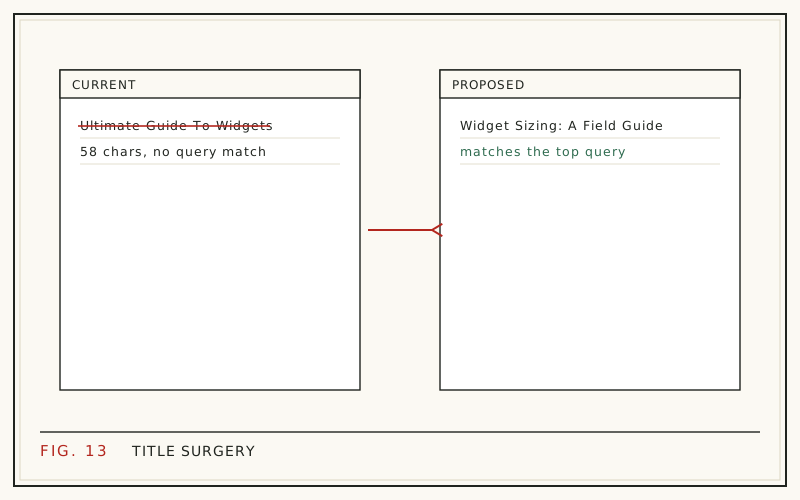
Keep titles around 50 to 60 characters, put the words searchers actually type near the front, and treat the meta description as ad copy for the click. That is most of what reliably works. Rewriting titles and meta descriptions is the fastest, lowest-risk refresh you can make to an old post, because it changes how the page competes on the results page without touching a word of the content behind it.
The stakes are bigger than most people assume. Zyppy's 2022 study of 80,959 title tags found that Google rewrote 61.6% of them, usually because the original was too long, too vague, or stuffed with keywords. The title you wrote three years ago may not even be the one searchers see today.
This guide covers what the data supports, what it does not - question titles, for one - and how to tell whether a rewrite actually moved clicks.
Why title rewrites are the fastest refresh win
Most refresh work tries to recover rankings, and rankings take weeks of content effort to move. A title rewrite pulls a different lever: click-through rate. It earns more clicks from whatever position the page already holds, and the edit itself takes minutes, not hours.
That matters for decaying posts because CTR often fades before rankings do. A headline with a stale year in it, a title written for a query that has since shifted, or a description Google truncates will quietly lose clicks to fresher-looking competitors at the very same position. We covered the symptoms in how aging titles quietly lose clicks; this post is the repair manual.
What is the best title length for CTR?
Backlinko's click-through study of 4 million search results, updated in 2025, found that titles of 40 to 60 characters earned an 8.9% higher average CTR than titles outside that range. Mid-length titles display fully on most devices, and, as the next section shows, Google is far more likely to leave them alone.
Aim for roughly 50 to 60 characters when you rewrite. That is long enough to carry the target query plus one concrete differentiator, and short enough to avoid truncation. If you have to cut something, cut the brand suffix before you cut the query.
Why does Google rewrite your titles?
Google rewrites a title when it decides the original will not help the searcher: too long, boilerplate, keyword-stuffed, or mismatched with what the page covers. Length is the loudest signal. In Zyppy's 2022 dataset, titles over 70 characters were rewritten 99.9% of the time, while titles of 51 to 60 characters saw the fewest rewrites, at 39 to 42%.
You cannot force Google to keep your title, but you can make keeping it the easy choice:
- Stay under about 60 characters.
- Keep the title tag and the on-page H1 consistent.
- Cut brand boilerplate and repeated keywords.
- Say plainly what the page delivers.
Title patterns that earn clicks
A few patterns consistently pull their weight on refreshed posts:
- Mirror the query: use the phrasing searchers type, not your internal jargon.
- Front-load: the first four or five words do most of the work in a scan.
- Add one concrete hook: a step count, 'checklist', 'template', or 'with examples'.
- Signal freshness honestly: include a year only if the content genuinely covers it.
- Match intent: a how-to query wants a how-to title, not an essay title.
One pattern per title. Stacking three hooks at once reads like a banner ad, and it is exactly the kind of title Google tends to rewrite.
Do question titles get more clicks?
No - not measurably. The same Backlinko dataset found no significant CTR difference between question and non-question titles, 15.5% versus 16.3%. The claim that questions boost clicks gets repeated constantly, but the largest public dataset does not support it.
Use a question title when the target query is itself a question, because mirroring the searcher's phrasing still matters. Just do not contort a statement-shaped topic into a question hoping for a click bonus. The bonus is not there.
Mirror the queries you already rank for
Open Search Console, filter the performance report to the page, and read its top queries by impressions. The rewritten title should contain the highest-impression query in something close to the searcher's own words. Old posts drift: the query mix a page earns in year three is often different from the one it was written for, and the title never caught up.
This is the core move in a title refresh, and it is why guessing at keywords underperforms. The queries report shows exactly what Google already surfaces the page for; the walkthrough in how to find decaying content in Search Console covers that report step by step.
Meta descriptions are ad copy, not a ranking factor
Meta descriptions do not influence rankings, and Google replaces them freely with text pulled from the page. Write a good one anyway: when Google does show it, it is your one sentence of ad copy under the title.
A working formula for a refreshed description:
- State the answer or outcome in the first clause.
- Include the primary query - Google bolds matching words in the snippet.
- Stay within roughly 140 to 160 characters.
- End with the reason to click through: the checklist, the data, the template.
Skip the hype. A description that promises exactly what the page delivers also earns the visit after this one.
Before and after: three common rewrite patterns
Three patterns cover most aging titles you will meet in a refresh queue:
| Before | The problem | After |
|---|---|---|
| Ultimate Guide to Email Marketing (2021) | Hype word plus stale year | Email Marketing Guide: Setup, Sequences, Metrics |
| 10 Tips - MyBrand Blog - Marketing Resources | Boilerplate crowds out the query | 10 Email Subject Line Tips (With Examples) |
| Everything You Need to Know About Choosing CRM Software for Your Small Business | 79 characters, near-certain rewrite | How to Choose a CRM for a Small Business |
Each rewrite keeps the query, drops the filler, and lands in the display-safe range.
How do you know the rewrite worked?
Compare CTR at a similar average position, before versus after, using 28-day windows. CTR alone can mislead: if position also moved, the CTR change may just reflect the new position, since higher slots always get more clicks. So note the rewrite date, wait two to four weeks for Google to recrawl and for data to settle, then compare windows where position held roughly steady.
If CTR rose at the same position, the rewrite worked. If the results page still shows Google's own substitute title, revisit length and query match. The full workflow, including annotation habits, is in how to measure content refresh results.
Where RefreshRank fits in a title refresh
RefreshRank handles the two slow parts of this job. The free WordPress plugin reads up to 16 months of your site's own Search Console history in 28-day windows, scores each page for decay, and sorts the queue by win-back potential, so you rewrite the titles most likely to repay the effort first. Detection runs on one site free, forever - no card, no signup form.
Paid plans add drafted title and meta description rewrites informed by the page's top real queries. Every draft appears as a current-versus-proposed diff that you approve, edit, or reject, and every applied change is a standard WordPress revision you can roll back in one click. Nothing ever publishes on its own. Scope details live in the rewrites documentation.
Questions
How long should a title tag be?
Aim for roughly 50 to 60 characters. That range displays fully on most devices, carries the query plus one hook, and in the studies covered above showed both the higher CTR and the lowest Google rewrite rate. Keep the most important words near the front, because the first few words carry the scan.
Why does Google keep rewriting my titles?
Usually length or mismatch. Titles far over 60 characters get rewritten almost universally, and Google also replaces titles that are boilerplate, keyword-stuffed, or out of step with the query. Shorten the title, align it with your H1, and make it describe what the page delivers. You cannot force Google's hand, but those changes make keeping your title the easy choice.
Do meta descriptions affect rankings?
No. The meta description is not a ranking signal, and Google often swaps it for text pulled from the page. Write one anyway: when it is shown, it works as ad copy under your title, and a description that states the outcome and mirrors the query can lift click-through rate without any ranking change.
Should I put the year in my title?
Only if the content genuinely covers that year and you commit to maintaining it. A current year can help on time-sensitive topics, but a stale year does the opposite and is one of the most common causes of CTR decay on old posts. If you will not update the post annually, leave the year out.
Do question-style titles get more clicks?
The best available data says no. Backlinko's CTR study found no significant difference between question and non-question titles. Use a question when the query itself is a question, since matching the searcher's phrasing matters, but do not expect the question mark alone to add clicks.
How soon will a title rewrite show results?
Google usually recrawls active pages within days, but give the data two to four weeks before judging. Search Console reporting lags by about two days, and daily CTR is noisy. Compare 28-day windows before and after the rewrite, at a similar average position, to see the real effect.
Should I rewrite titles on every old post?
No. Prioritize pages with meaningful impressions and declining clicks, where a CTR gain converts into real traffic. A page with forty impressions a month will not repay the effort; a page holding position four with a fading title will. Work a queue sorted by likely recovery, not by publish date.
Can I change a title without hurting rankings?
Title changes are low-risk when the new title still matches the page's main query and content. The risk appears when a rewrite drifts away from the query the page already ranks for, so anchor the new title in the top queries from Search Console. The URL stays the same, so no redirect is ever needed.
Sources
- Zyppy - Google Rewrites 61% of Page Title Tags (2022)
- Backlinko - We Analyzed 4 Million Google Search Results (2025)