 RefreshRank
Declining CTR: How Aging Titles Quietly Lose Clicks
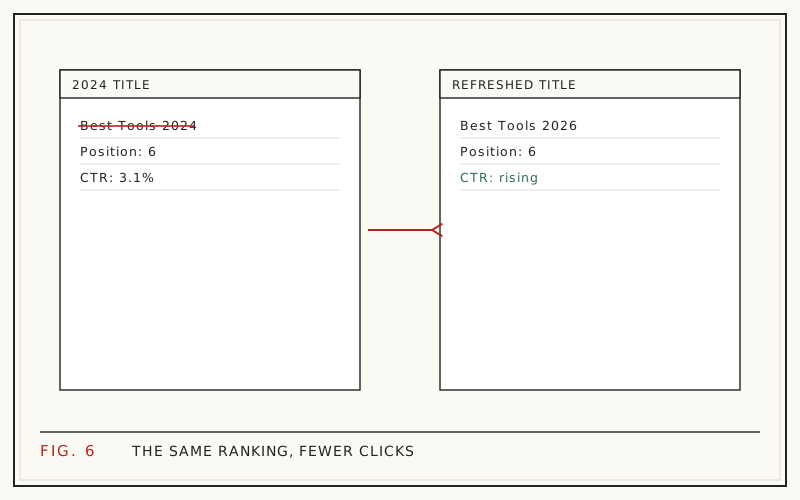
Titles age, and clicks fade with them. A post can hold its ranking for years while its CTR quietly declines, because three forces work against an aging snippet: the title itself starts to look dated, the results page around it gets busier, and Google increasingly rewrites titles it no longer trusts. The traffic loss is real, but most dashboards call it nothing - position looks fine.
The pattern is easy to confirm in Search Console, and it is cheaper to fix than almost any other SEO problem, because the remedy is a line of text. Here is how to spot declining CTR, what the click curve says it costs you, and how to write titles that hold up over time.
First, confirm it is a CTR problem
Open Search Console's Performance report, enable all four metrics, and compare the last 28 days to the same 28 days a year earlier. You are looking for one specific pattern per page: average position roughly steady, CTR down.
If position fell too, you have a ranking problem first - see what a dropping average position means - and no title rewrite rescues a page that slid off page 1. The full comparison workflow is in our Search Console guide. Assuming position held: the snippet is losing the click, and the title is the biggest lever in the snippet.
What normal CTR looks like at each position
Before judging a page's CTR, know the baseline for its position. Backlinko's study of 4 million search results measured average organic CTR by position (Backlinko, 2025):
| Position | Average organic CTR |
|---|---|
| 1 | 27.6% |
| 2 | 15.9% |
| 3 | 11.0% |
| 5 | 6.5% |
| 10 | 2.0% |
The table has two uses. A page sitting well below its position's baseline has room to gain from a better snippet. And a page whose CTR is drifting downward at a stable position is decaying in the one place a rank tracker will never show you.
How titles age
Nothing on the results page announces that a title is old, but searchers read the signals instantly.
- Year stamps: "Best CRM Software 2024" on a 2026 results page is an argument for clicking someone else. A stale year is worse than no year.
- Outdated counts and claims: "7 Tools" next to a competitor's "15 Tools", prices that no longer exist, a "new feature" that shipped three years ago.
- Faded phrasing: query vocabulary drifts, and a title mirroring 2021's wording matches fewer of 2026's searches word for word.
- Intent mismatch: the dominant intent behind a query can shift under a stable ranking, leaving the title's promise beside the point.
Each signal shaves a fraction of a percentage point. Over a year, the fractions add up to a visible CTR slide.
The results page got more crowded too
Even a perfect title now competes with more furniture than it used to: AI-generated answers, People Also Ask boxes, featured snippets, video carousels, shopping units. SparkToro and Datos measured the outcome: 58.5% of US Google searches ended without any click to the open web, and for every 1,000 US searches only 374 clicks reached open-web sites (SparkToro, 2024).
You cannot vote the features off the page. The practical conclusion is that the remaining clicks concentrate on the snippets that most precisely promise what the searcher wants - which raises the cost of a vague or dated title a little more every year.
Google rewrites titles it does not trust
Your title tag is a suggestion, not a guarantee. Zyppy's study of 80,959 title tags across 2,370 sites found that Google rewrote 61.6% of them (Zyppy, 2022). Length was the strongest signal: titles over 70 characters were rewritten 99.9% of the time, while titles in the 51-60 character range were rewritten least (Zyppy, 2022).
An overlong, keyword-stuffed, or page-mismatched title invites Google to substitute its own version - often truncated or blander than anything you would have chosen. Keeping titles tight and honest is not just a CTR play; it is how you keep editorial control of your own snippet.
Title patterns that hold up
The same Backlinko dataset offers two measured levers: titles of 40-60 characters earned 8.9% higher average CTR than titles outside that range, and positive-sentiment titles earned 4.1 percentage points more (Backlinko, 2025). Just as usefully, question-style titles showed no significant CTR advantage in that data - so treat "turn it into a question" advice with suspicion.
Beyond the numbers, the patterns that age well:
- Mirror the query's current wording, not the wording from the year you wrote the post.
- Promise something concrete the page actually delivers: steps, a comparison, a direct answer.
- Use a year only if you will maintain it every year; otherwise write an evergreen title.
- Front-load the meaningful words so truncation cannot hide them.
Detailed rewrite mechanics are in rewriting titles and meta descriptions for CTR.
Dates are part of the snippet
Many results show a date beside the snippet, and searchers use it exactly the way they use year stamps in titles: as a freshness filter. A 2022 date under an otherwise strong title suppresses clicks on any query where recency matters.
The fix is honest updating: change the visible date only when you have genuinely revised the content, and keep dateModified truthful in your structured data. Bumping dates on untouched posts is a move Google's guidance explicitly warns against, and it erodes trust with repeat visitors too. We cover the honest version in stale dates in search results and how to update dates without faking freshness.
Rewrite the meta description in the same pass
The meta description is the supporting line of the same ad. Google substitutes its own text often, but when yours is shown, it should state the page's answer or value in plain words that mirror the query - roughly 140 to 158 characters, no hype. A title-and-description pair that reads like a direct response to the search gives the searcher a reason to click; a pair that reads like a label leaves it to chance.
When you refresh a title, refresh the description in the same edit. The two are judged together on the results page and measured together in your CTR column.
A monthly workflow for catching CTR decay
The whole detection-and-fix loop fits in under an hour a month:
- Compare the last 28 days to the same window last year in Search Console.
- List pages where position held but CTR fell.
- Check each title against the live SERP: year stamps, phrasing, what competitors promise.
- Rewrite the title and meta description, keeping the title in the 40-60 character zone.
- Log the change date and re-check after the next full window.
This is also the loop RefreshRank automates on WordPress sites: it flags pages whose clicks are fading against their own 16-month history, then drafts title and meta description rewrites informed by the page's actual top queries. Every draft appears as a current-vs-proposed diff you approve or reject, and applied changes are ordinary WordPress revisions you can roll back. The detection queue is free on one site via the plugin on wordpress.org.
Measuring the rebound
Title changes show up fast by SEO standards: Google usually recrawls active pages within days, and CTR shifts follow. Even so, judge the result only on a full 28-day window against the pre-change baseline, at matching positions - if the position moved meanwhile, the CTR comparison is contaminated by the click curve.
A realistic win is a partial climb back toward the baseline for your position, not an overnight doubling. Track every title change the same way, in one log, and the small wins compound quietly across the site. The full method is in how to measure content refresh results.
Questions
Should I put the current year in my blog post titles?
Only if you will actually maintain it. A current year can help on queries where searchers want fresh information, but a stale year actively costs clicks - it is a visible argument against your result. If annual upkeep is not realistic, write an evergreen title with no year at all. And never bump the year without genuinely updating the content behind it.
Why does Google show a different title than the one I wrote?
Google rewrites titles it considers too long, too vague, keyword-stuffed, or mismatched with the page - Zyppy's 2022 study found this happened to a majority of the titles it analyzed, and to overlong titles almost every time (Zyppy, 2022). Keeping titles roughly 50-60 characters and closely matched to the page content is the most reliable way to keep the version you wrote.
What is a good CTR for my page?
It depends almost entirely on position, so compare against position baselines and your own page's history rather than one universal number. A page at position 3 earning 4% is underperforming; a page at position 9 earning 4% is doing well. The most actionable signal is the trend: CTR drifting downward while position stays stable.
How quickly will a new title change my CTR?
The new title can appear in results within days once Google recrawls the page, and you can request indexing in Search Console to hurry it along. But do not judge success on the first week. Compare a full 28-day window after the change against the window before it, at the same position, to get past day-to-day noise.
Can changing a title hurt my rankings?
A scoped, honest title change rarely does. Keep the terms your core queries use, keep the title accurate to the page, and change one thing at a time so you can attribute the result. What does carry risk is wholesale re-targeting: a new title aimed at a different query set is a re-optimization, not a refresh, and rankings can move either way.
Do question-style titles get more clicks?
Not measurably. In Backlinko's 4-million-result dataset, question titles performed about the same as non-questions (Backlinko, 2025), despite how often the advice is repeated. Write a question when the query genuinely is one, and a plain statement otherwise. Clarity and query match matter more than format.
Should I A/B test titles?
True A/B testing is impossible in organic search - Google shows one title at a time to everyone. The practical substitute is sequential testing: change the title, compare full 28-day windows before and after at matching positions, and keep a log of what changed and when. One page at a time, one change at a time, is slow but attributable.
Is declining CTR always a title problem?
No. New SERP features can absorb clicks regardless of your snippet, a competitor's richer result can outdraw yours, and on some queries an AI answer satisfies the searcher outright. The title is simply the part you control most directly and the cheapest to fix - so start there, and look at the live SERP before concluding anything.
Sources
- Backlinko - We Analyzed 4 Million Google Search Results (2025)
- SparkToro + Datos - 2024 Zero-Click Search Study (2024)
- Zyppy - Google Rewrites 61% of Page Title Tags (2022)