 RefreshRank
Productizing Content Refreshes: A Service Agencies Can Sell
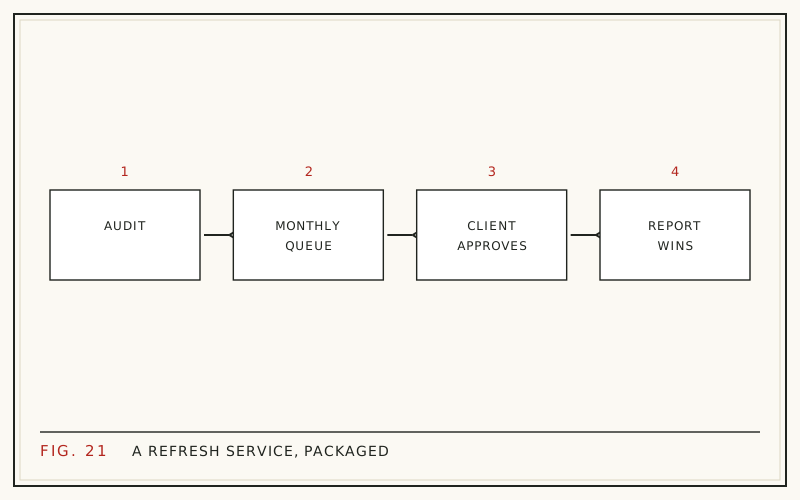
A productized content refresh service is a fixed-scope, fixed-price offer: each month, the agency updates a set number of a client's existing pages - titles, meta descriptions, intros, FAQs, dates - and reports the results from the client's own Search Console data. It packages well because the scope repeats cleanly, the raw material already exists, and the outcome is measurable.
The evidence that refresh work pays is unusually solid. HubSpot's historical optimization program lifted monthly organic search views of updated posts by an average of 106% (HubSpot, 2015 analysis, updated 2025). This guide covers how to scope, price, deliver, and prove a refresh service without overpromising.
Why refresh work suits a productized service
Custom SEO retainers are hard to scope and harder to explain. Refresh work is the opposite: the unit is a page, the checklist per page is stable, and the before-and-after shows up in data the client already owns.
Three properties make it package-able:
- Repeatable scope: every refreshed page gets the same defined treatment, so effort per unit is predictable
- Existing raw material: you are improving content the client already paid to create, which is an easy story to tell
- First-party proof: results appear in the client's own Search Console, not in a third-party tool's estimates
Most mature blogs also carry a deep backlog of decayed pages, so the pipeline rarely runs dry. The service can run for years on a site that publishes regularly.
What the market pays for SEO work
Price a new offer against what buyers already spend. Ahrefs' survey of 439 SEO providers found an average retainer of $2,917 per month (Ahrefs, 2024), while Backlinko's survey of over 300 SEO professionals put typical overall SEO spend at $1,000 to $2,500 per month (Backlinko, updated 2025).
A refresh-only service naturally sits below a full-service retainer, since it excludes link building, technical work, and new content production. That is a feature, not a weakness: it gives smaller clients a credible entry point under full-retainer pricing, and gives existing clients a clearly bounded add-on that does not cannibalize the main engagement.
Scope the per-page deliverable tightly
Vague scope kills productized services. Define exactly what one refreshed page includes and put it in the proposal:
- Title and meta description rewritten against the page's current top queries
- Introduction reworked to answer the query directly
- An FAQ block covering real related questions
- Facts, examples, and dates checked and corrected
- Internal links added from and to related pages
Just as clearly, list what it excludes: full rewrites, brand-new articles, link outreach, and site-speed work. Clients respect a tight boundary more than a fuzzy everything-adjacent one, and your margins depend on holding it. The full per-page process is in our refresh playbook.
Choose a cadence the client can see
Monthly batches work best. A rhythm of five to ten refreshed pages per month is large enough to move numbers on a mid-sized site and small enough to execute reliably alongside other client work.
Cadence is also the retention mechanism. Each month the client sees a named list of pages touched, the specific changes made, and last month's pages starting to move. Quarterly cadences save coordination overhead but leave the service invisible for too long between touchpoints - and invisible line items are the ones that get cut at renewal time.
Pricing structures that fit refresh work
Three structures fit, roughly in order of how productized they feel:
| Structure | How it works | Best for |
|---|---|---|
| Per-page | Fixed price per refreshed page, with a minimum batch | First engagements, easy math |
| Tiered retainer | Small, medium, and large monthly batches at set prices | Ongoing clients, predictable revenue |
| Audit plus retainer | Paid one-time audit whose findings feed the retainer | Skeptical prospects |
Anchor your tiers against the market figures above rather than against your hours. And whichever structure you pick, publish it - a productized service with hidden pricing is just a custom retainer wearing a costume.
Use the audit as the entry point
The natural sales motion starts with evidence, not a pitch. A content decay audit of the prospect's own site - which pages declined, by how much, and what they once earned - turns an abstract service into a specific, recoverable loss. It also scopes the first three months of retainer work before the contract is signed, which protects both sides from a vague start.
Structure that first deliverable using our content audit deliverable guide, and see pitching content decay to skeptical clients for handling the conversation itself.
Prove results with before-and-after windows
Decide the reporting method before the first page is touched. For each refreshed page, record the refresh date, then compare 28-day Search Console windows before and after: clicks, impressions, CTR, and average position for that page. Give changes six to eight weeks before judging, and report page-level wins by name rather than sitewide averages that blur the signal.
Be honest about attribution: algorithm updates and seasonality move numbers too. Reporting a batch of pages rather than a single anecdote smooths some of that noise. The mechanics are covered in measuring content refresh results.
Where tooling fits the workflow
Margins on a productized service come from cutting the undifferentiated hours: finding decayed pages, drafting routine edits, assembling reports. Detection is the clearest case - checking Search Console page by page across many client sites simply does not scale by hand.
This is the job RefreshRank was built for. It reads each site's own Search Console history in 28-day windows, scores decay per page, and sorts the queue by estimated win-back potential. Proposed edits appear as diffs of current versus proposed copy that your team approves or rejects, and approved changes apply as standard WordPress revisions. The Agency plan adds white-label client reports carrying your brand, with public share links. The plugin is free for decay detection on one site, so you can trial the workflow on your own blog first. What stays human is the judgment: which pages, which edits, which clients - see white-label SEO reports clients actually read for the reporting side.
Refresh retainers are retention machines
Recurring, visible, mid-priced work is what keeps clients around. In AgencyAnalytics' benchmarks survey of 494 agency professionals, 62% of clients stay with their agency for two years or more (AgencyAnalytics, 2026) - and retainers that produce a monthly artifact the client can point to are the kind that last.
Refresh work fits that shape unusually well. Every month produces named pages, concrete diffs, and movement in first-party data. When budgets tighten, a line item that shows its receipts survives review better than one promising long-term brand effects. Retention is where a modest monthly price quietly compounds into real revenue.
Five mistakes that sink refresh services
- Guaranteeing rankings: you control the work, not Google - sell recovery effort and honest measurement
- Picking pages by gut feel instead of decline data, so effort lands where there is nothing to win back
- Letting scope creep from refreshes into free full rewrites
- Reporting sitewide traffic instead of the specific pages touched
- Hiding the work: if the client cannot see what changed, the service reads as a fee
Priced clearly, scoped tightly, and proven from the client's own data, a refresh service is one of the most defensible offers a small agency can run.
Questions
How much should an agency charge for a content refresh service?
Anchor against what buyers already spend on SEO overall - see the survey figures above - then price the refresh service below a full retainer, since it excludes link building and new content. Per-page pricing with a monthly minimum is the simplest structure to sell; tiered monthly batches suit ongoing clients. Publish the price, because hidden pricing undercuts the productized positioning.
How many pages should a refresh retainer cover per month?
Five to ten for most mid-sized sites. Fewer than five and results take too long to surface; many more and quality control slips, especially with a small team. Let the client's decay queue set the ceiling: if only a dozen pages show meaningful win-back potential, a smaller batch with honest scoping beats padding the count with pages that were fine already.
How long before a refreshed page shows results?
Plan for six to eight weeks per page, sometimes faster for title and meta changes that only need a recrawl to start shifting CTR. Set that expectation in the proposal so month-one reporting can honestly show work delivered rather than results. Compare 28-day Search Console windows before and after each page's refresh date, and judge the batch, not one page.
What is the difference between a content audit and a refresh service?
The audit is a one-time diagnosis: inventory, decay findings, and a prioritized roadmap. The refresh service is the ongoing treatment that works through that roadmap in monthly batches. Selling them separately works well - the audit is a low-commitment first purchase that proves the problem with the client's own data, and its roadmap becomes the retainer's first quarter of work.
Do clients still need new content if they buy refreshes?
Usually yes, eventually. Refreshes recover and defend existing demand; new content captures demand the site has never addressed. For a site with a large decayed archive, refresh-first is often the smarter sequence because it costs less per recovered click. Be straight about the boundary - positioning refreshes as a replacement for all content creation overpromises.
What should the monthly deliverable include?
A short report: the named pages refreshed, what changed on each - before-and-after titles and metas make it tangible - the prior batch's 28-day trend, and next month's planned pages. One page or one screen is enough. Agencies that keep reporting light protect their margin, and clients actually read short reports; long ones get skimmed and forgotten.
Can a two-person team run a refresh service?
Yes, if detection and drafting are assisted and approval stays human. One person owns client communication and final review; drafting scoped edits is the part tools can accelerate safely, since every change is reviewed before it ships. The bottleneck to watch is editorial judgment during review - protect time for it rather than growing batch size past it.
Should a refresh service guarantee ranking improvements?
No. Rankings depend on Google's systems, competitors, and factors outside any agency's control, and guarantee language attracts exactly the clients who churn when a core update lands. Guarantee the process instead: pages refreshed on schedule, changes documented, results measured in the client's own Search Console. That is a promise you can always keep.
Sources
- Ahrefs - SEO Pricing Survey of 439 Providers (2024)
- Backlinko - SEO Pricing: How Much Does SEO Cost? (updated 2025)
- AgencyAnalytics - 2026 Marketing Agency Benchmarks Report (2026)
- HubSpot - Optimizing the Past: Historical Blog SEO (2015, updated 2025)