 RefreshRank
White-Label SEO Reports Clients Actually Read
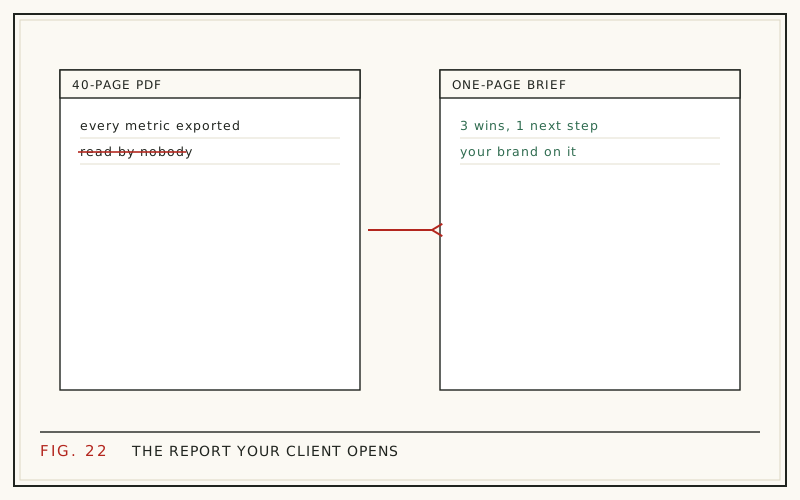
A white-label SEO report clients actually read is short, carries your agency's brand, and answers three questions in plain language: what changed this month, why it matters, and what happens next. If a client can absorb it in five minutes, it is working. If they need a call to decode it, it is a data export, not a report.
Most reports still miss that bar. Dashboards dump forty metrics because exporting everything is easier than choosing what matters, and the client quietly stops opening the email. This guide covers what belongs in a client-readable report, what to cut, why the branding matters more than most agencies admit, and how live share links change the way reports get read and forwarded.
Why do most SEO reports go unread?
Because they are written for the person who built them. A 200-row keyword table is useful to you. To a client who runs a plumbing company or a software product, it is noise. They skim the first page, look for one number that sounds like money, and archive the email.
The fix is editorial, not technical. Decide the single story of the month before you open a chart, then cut everything that does not support it. Clients paying the average retainer of $2,917 a month (Ahrefs SEO Pricing Survey, 2024) are not buying data - Google gives them that for free in Search Console. They are buying judgment, and the report is the one place each month where that judgment is visible.
What belongs in a client-readable report
A readable report fits on two or three pages and follows the same structure every month, so the client learns exactly where to look. The core parts:
- A three-sentence summary at the top: what happened, why, and what is next.
- Three to five metrics with a clear trend, not forty.
- Wins in plain words: 'the pricing guide recovered 400 monthly clicks'.
- Work completed this month, as a short list.
- Next month's plan, with one clear ask if you need something from the client.
Nothing else earns a place by default. If a chart does not change what the client believes, approves, or pays for, it belongs in your working file, not the deliverable. And if the monthly report grew out of a bigger annual review, keep the two documents separate - a content audit deliverable has its own structure and its own job.
Which numbers do clients actually care about?
Pull them from the client's own Google Search Console property, not from third-party traffic estimates. First-party data survives scrutiny in a way estimates never do; there is a full walkthrough in our guide to client reporting from Search Console.
| Metric | Why it earns a place |
|---|---|
| Organic clicks, last 28 days | The closest thing to 'people arrived from Google' |
| Clicks vs the same 28 days last year | Separates real change from seasonality |
| Pages recovered or improved | Ties your work directly to an outcome |
| Top three winning pages | Gives the client something concrete to talk about |
| Leads or sales from organic, if tracked | The number your invoice is judged against |
Average position deserves caution. It moves for reasons unrelated to your work, and explaining that every month wears thin. Clicks and named page wins carry the same information with far less confusion.
What should you leave out?
- Keyword-by-keyword rank tables. Track them internally, report the outcome.
- Third-party visibility scores. The client cannot act on them, and a competitor's tool will happily contradict them.
- Jargon. Crawl budget, canonicalization, and schema markup can all be translated into plain words or omitted.
- Raw tool screenshots. They carry someone else's branding and nobody's context.
A useful test: anything that needs a footnote to make sense to a non-SEO gets cut or rewritten. The working data does not disappear - it moves to an appendix link for the rare client who wants depth, and stays out of everyone else's way. Cutting is uncomfortable the first month and invisible by the third.
Write the narrative before you paste the charts
Open a blank page and write the month's story in three sentences: what happened, why, and what you will do about it. Then pick the two or three charts that prove those sentences. Working in that order stops the report from becoming an inventory of everything measurable.
Address the client directly and use their words for their goals. If they call organic leads 'website enquiries', the report says 'website enquiries'. Reports written in the client's own vocabulary get forwarded internally without translation, which is exactly what you want - the forwarded report is doing your account management for you.
Why does white-label branding matter?
The monthly report is often the only artifact from your engagement that a client's boss, board, or business partner ever sees. If it arrives stamped with a tool vendor's logo, the tool gets the credit and you look like a middleman. If it carries your name, logo, and colors, the work reads as yours - because it is.
Branding also keeps the deliverable stable while your stack changes underneath it. Tools come and go; the client should never notice. A white-label layer means the report looks identical in month twenty even if the machinery behind it moved twice, and that consistency is part of what makes an agency feel established rather than improvised.
Share links beat PDF attachments
A live share link opens on a phone, needs no login, and does not get buried in an inbox the way an attachment does. It also lets a client forward the report internally without you losing control of freshness - the link shows current data, not a snapshot that ages in someone's downloads folder.
RefreshRank takes this approach for content-decay reporting on its Agency plan: reports carry your brand name, logo, and accent color, and go out as public share links that stay live for 30 days with no client login. The numbers behind them come from the client's own Search Console history, which keeps every conversation grounded in first-party data rather than estimates.
How long should a report take to build?
Under an hour is now the norm. 73% of agencies complete a client report in under an hour, and 46% finish in under 30 minutes (AgencyAnalytics, 2026 Marketing Agency Benchmarks). If yours takes an afternoon, the assembly is manual somewhere it does not need to be.
Templates and automated data pulls are how the fast agencies do it. The point is not to spend less total time on reporting - it is to move the saved time into the three sentences at the top, which are the only part most clients read in full. An hour spent writing a sharp summary beats three hours formatting charts nobody studies.
Good reporting is a retention tool
Clients rarely leave agencies that make results legible. In AgencyAnalytics' 2026 benchmarks survey of 494 agency professionals, 62% of clients stay two years or longer. A report the client actually reads - and can defend to their own boss without you in the room - is part of how that happens.
The deeper version of this is proving value with the client's own search data rather than industry averages or tool estimates. Their pages, their queries, their recovered clicks. We cover that approach in proving SEO value to clients.
End every report with next month's plan
A report that only looks backward invites the question 'so what am I paying for now?'. Close with two or three concrete items for next month, each tied to a page or a goal the client recognizes, so the retainer always has a visible forward edge.
If content refreshes are part of your service, this is where before-and-after windows shine: name the pages you refreshed this month, then show the comparison a month later. Our guides to measuring refresh results and productizing refresh work cover how to structure both the work and the proof.
Questions
What is a white-label SEO report?
A report built from your client's data but presented entirely under your agency's brand - your name, logo, and colors - with the generating tool invisible. Agencies use white-label reports so the deliverable reads as their own work product, keeps a consistent look even as the tool stack changes, and supports a reporting line inside a retainer.
How many metrics should a monthly SEO report include?
Three to five. Organic clicks, a year-over-year comparison, pages recovered or improved, and a business outcome such as leads cover most engagements. Every additional metric dilutes the ones that matter and pushes the client toward skimming. Keep the rest in a working file you can share when someone asks a specific question.
Should I report average position to clients?
Sparingly. Average position is impression-weighted, so it can drop simply because the site started appearing for new queries - good news that looks like bad news. If you include it, pair it with clicks and explain movements in one plain sentence. For most clients, clicks and named page-level wins communicate more with less confusion.
Are PDFs or live share links better for client reports?
Links, in most cases. They open anywhere, need no login, and can show current data instead of an aging snapshot. PDFs still have a place when a client needs a fixed record for a board pack or compliance file. A practical middle ground: send the link by default, offer the PDF on request.
How often should agencies send SEO reports?
Monthly for most retainers. SEO moves slowly enough that weekly reports amplify noise, and quarterly reports leave clients guessing in between. A short monthly report plus a quarterly review call covers both rhythms: the report keeps the work visible, the call handles strategy, scope, and renewals.
How do I report a bad month?
Lead with it. State the drop, the most likely cause, and the response plan in the summary - never bury it under positive charts. Clients forgive bad months; they do not forgive discovering one on their own. A named cause and a dated plan turn a bad month into evidence that you are watching closely.
How long does it take to build a white-label report?
With a template and automated data pulls, under an hour is standard - 73% of agencies finish a client report in that time, and 46% within 30 minutes (AgencyAnalytics, 2026). The first report for a new client takes longer because you are choosing metrics and writing the baseline story. Every month after that, the template does the assembly.
What does the client see when I send a shared report link?
Whatever the tool exposes publicly, so check before sending: metrics, branding, and date ranges. Good white-label links show your brand only, need no account, and expire after a set period so stale data does not keep circulating. Open every link once in a private browser window before it goes to the client.