 RefreshRank
Proving SEO Value to Clients With Their Own Search Data
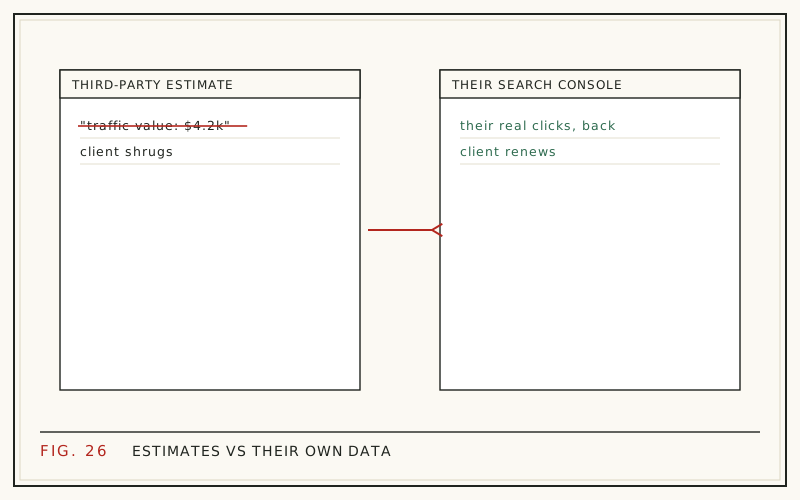
The strongest proof of SEO value is the client's own Google Search Console data: real clicks, real queries, recorded by Google itself. Third-party traffic estimates are modeled guesses about someone else's website, and sooner or later a client compares them against their own analytics, sees the gap, and starts discounting everything in your reports.
The stakes are the retainer itself. Businesses commonly pay $1,000-$2,500 a month for SEO, per Backlinko's survey of 300+ SEO professionals (updated December 2025), and the question behind every renewal is the same: what did that money measurably do? First-party data is how you answer without asking to be trusted.
Why third-party estimates weaken your case
Rank trackers and traffic estimators are useful research tools, but their traffic numbers are modeled: extrapolated from a keyword database, average click curves, and assumptions about the site. They routinely disagree with a site's own analytics by large margins, in either direction, and there is no way to know in advance which direction.
Clients notice. The moment someone on the client side asks why your report shows one number and their dashboard shows another, the conversation is about your tooling instead of your work. You are now defending a model you did not build and cannot inspect. Reports built on the client's own data never have this conversation, because there is only one number and Google produced it.
What Search Console actually measures
Google Search Console reports what Google recorded for that specific site: how many times its pages appeared in search results (impressions), how many times searchers clicked through (clicks), which queries triggered those appearances, and the average position for each. It is not a sample from a keyword database. It is the ledger of what actually happened between Google's results and this site.
That provenance is the entire argument. When a report shows the site's clicks from Google search, the source is Google. There is no more authoritative place the number could come from, and clients grasp that instantly - no methodology slide required.
Estimates versus measurements, side by side
| Question | Third-party estimate | Search Console |
|---|---|---|
| Where the number comes from | Model built on a keyword database | Google's records for this exact site |
| Query coverage | Keywords the tool happens to track | Every query that surfaced the site |
| When challenged | You defend the tool's model | The source is Google itself |
| Best use | Competitive research and prospecting | Client reporting and proof |
Both have a place. Estimates are for looking at sites you do not control: competitors, prospects, market sizing. But the moment you have access to the real thing, reporting from estimates is a self-inflicted credibility risk that gains you nothing.
The numbers clients actually understand
Skip the composite scores. Three things land reliably in client conversations:
- Clicks: visits from Google search, the closest Search Console gets to revenue-adjacent
- The queries themselves: showing a client the exact words their customers typed is often the single most persuasive part of the meeting
- Before-and-after comparisons on specific pages: a story with a built-in baseline
What does not land: impressions growth presented alone, which is visibility without visits and invites the obvious question; sitewide average position, a summary number most clients misread; and any metric whose name includes the word score. If a number needs a paragraph of caveats, it is costing more trust than it buys.
Win-back stories: the easiest value to prove
A refreshed page is the cleanest value story in SEO because it carries its own control: this page earned this many clicks, declined measurably, we updated it on this date, and here is the recovery in the same report. No attribution modeling, no assumptions, one page and two windows.
The upside is real. HubSpot reported that updating old posts increased organic search views by an average of 106% across its own blog (analysis first published 2015). That is one company's blog, not a universal law - but it shows that before-and-after lifts of this kind are measurable and worth pursuing systematically. The mechanics of doing the work are in the refresh playbook, and measuring refresh results covers the evidence side.
Honest attribution: claim less, keep more
First-party data cuts both ways: it will also show seasonality, algorithm updates, and lifts you did nothing to cause. Claim those as wins and you eventually get caught by the same data you reported, which is a worse conversation than never having claimed them.
The discipline is simple. Record the date of every change you ship. Compare like-for-like windows. When a lift coincides with a Google update or a seasonal peak, say so, and separate it from your work where you can. Clients do not expect you to control Google. They expect you to be straight with them, and an agency that flags its own confounds earns the right to be believed about its wins.
Build the before-and-after with 28-day windows
The method: note the exact date a change went live, let a few weeks pass for Google to recrawl and for data to accumulate, then compare a full 28-day window after the change against the matching window before it. Twenty-eight days smooths out the weekday-versus-weekend swings that make shorter comparisons noisy, and equal windows keep the comparison honest.
This is mechanical work, which means it can be automated. RefreshRank, our WordPress plugin, syncs up to 16 months of a site's own Search Console history daily in 28-day windows and scores each page's decay against its own past - so the baseline for every before-and-after already exists the day you need it. Detection is free on one site, and getting started takes a few minutes.
When the numbers are down
Down periods are where first-party reporting proves its worth. An estimate-based report can only say traffic fell. Search Console lets you decompose the decline: which pages, which queries, clicks versus impressions versus CTR, and whether the same window last year shows the same dip - the tell that separates seasonality from real decay.
Budget pressure makes this urgent. AgencyAnalytics' 2026 benchmarks report, surveying 494 agency professionals, found 42% of agencies cite budget cuts and economic pressure as the top reason clients leave. When a finance lead is hunting for cuts, a vague report makes SEO the easiest line to delete. A precise one - here is exactly what declined, why, and the plan - is much harder to cancel.
From proof to renewal
Value proof is not a year-end event. Build it into the monthly rhythm: every report carries at least one specific page-level story backed by Search Console numbers, alongside the plan for the next one. By renewal time the case makes itself, because twelve small documented proofs beat one big retrospective deck every time.
The same evidence powers new business. Declining pages pulled from a prospect's own data are the strongest pitch material there is - pitching content decay work covers that conversation, and reporting from Search Console covers the monthly format that keeps the proof flowing.
Start with one page
You do not need a new reporting stack to start. Pick one client page that used to earn steady clicks and has visibly declined in Search Console. Refresh it: title, intro, outdated facts, whatever the queries say people actually want. Record the date. Compare 28-day windows six weeks later.
If the page recovers, you have a proof point in the client's own data that no estimate can match, and a template for every report after it. If it does not, you have learned something real about the page and lost very little. Either way, you have started reporting from ground truth, and that is the habit that survives budget reviews.
Questions
What counts as first-party SEO data?
Data generated by the client's own properties and accounts: Google Search Console, their analytics platform, their server logs, their CRM. It measures what actually happened to their site. Third-party data - rank trackers, traffic estimators, keyword databases - is modeled from the outside and is best treated as research input, not proof.
Why don't third-party traffic estimates match analytics?
Because they are estimates. Tools model traffic from a keyword database, assumed click-through curves, and sampled ranking data, so they miss queries they do not track and misjudge clicks on the ones they do. Large gaps in either direction are common. That is fine for sizing up competitors and useless for proving value.
How do I get access to a client's Search Console?
The client opens Search Console, goes to Settings -> Users and permissions on their property, and adds your Google account - view access is enough for reporting. If no property exists yet, help them verify one first. Keep ownership with the client; agencies should be added as users, not owners.
Which Search Console metric matters most in client reports?
Clicks. They are the closest Search Console gets to business outcomes and need no translation. Impressions, CTR, and position are diagnostic context that explains why clicks moved. Lead with clicks over an honest comparison window, then use the other three to tell the story behind the change.
How soon after a refresh will Search Console show results?
Allow time for Google to recrawl the page and for a clean comparison window to accumulate - in practice, judge results at four to eight weeks rather than days. Early movement can appear sooner, but reporting on a full 28-day window after the change keeps the comparison honest.
Can I promise clients specific rankings or traffic numbers?
No, and you should distrust anyone who does. Google's results shift constantly for reasons outside anyone's control. What you can promise is process and transparency: the work you will do, the first-party data you will report against, and honest accounting when results arrive - or when they do not.
What if the client's traffic declined during my retainer?
Report it before they find it, decomposed: which pages and queries drove the decline, whether the pattern looks seasonal, algorithmic, or like decay, and what you are doing about it. A precise account of a bad quarter builds more trust than a vague account of a good one.
Should I give clients raw Search Console access or a report?
Both, ideally. Encourage clients to hold their own access - it signals you have nothing to hide. But raw Search Console is confusing to non-specialists, so the monthly report is where you add value: selection, honest comparison windows, and interpretation in plain language they can forward internally.
Sources
- Backlinko - SEO Pricing: How Much Does SEO Cost? (2025)
- HubSpot - Optimizing the Past (2015)
- AgencyAnalytics - 2026 Marketing Agency Benchmarks Report (2026)