 RefreshRank
Is Content Freshness a Google Ranking Factor?
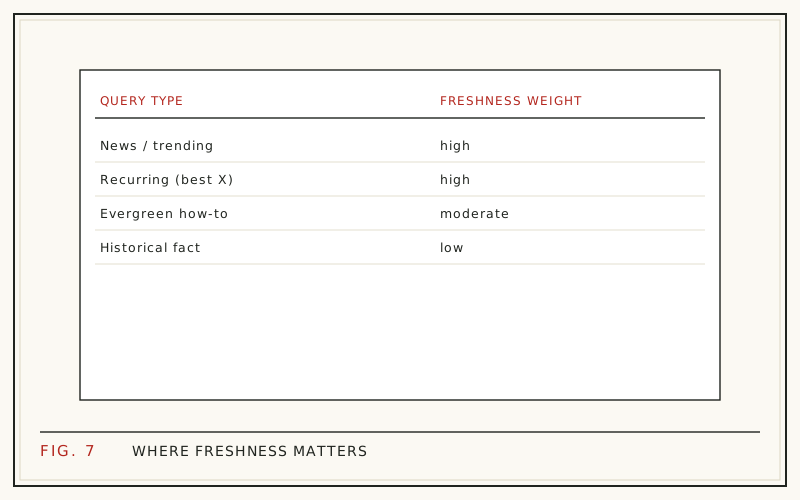
Sometimes, and only for some queries. Google treats freshness as a query-dependent signal: when a search calls for recent results, newer pages get weighted up, and for stable topics the date on a page barely registers. Google said its November 2011 freshness update would affect roughly 35% of searches (Search Engine Land, quoting Google's announcement, 2011), and that remains the only hard number Google has ever attached to freshness.
The confusion is understandable. Refreshed posts often recover traffic, so people conclude that Google rewards the date. Usually it rewards the work behind the date: better coverage, a title that matches how people search now, a direct answer near the top of the page.
This guide separates the two. What the evidence supports, where recency genuinely moves rankings, where it does nothing at all, and how to tell which case applies to your pages.
What did Google actually say about freshness?
Google announced the freshness update on November 3, 2011, saying the change would affect roughly 35% of searches - a figure Search Engine Land quoted directly from Google's post the same day (Search Engine Land, 2011). Fifteen years later it is still the number everyone reaches for, and it is routinely misread.
Two details get dropped. First, affected does not mean improved by recency: the 35% counted queries whose results shifted noticeably, in either direction. Second, Google's own examples were narrow. Recent events, regularly recurring events like elections and sports seasons, and topics that change often, such as which camera to buy this year.
Everything else sat outside the change. Google was describing behavior that varies by query, not a sitewide score for how recently you edited a post.
Freshness is a query modifier, not a general boost
The useful mental model is Query Deserves Freshness, usually shortened to QDF. Google works out how much recency a query calls for, then weights results accordingly. The same page can be helped by freshness on one query and completely unaffected on another.
You can test this in about a minute. Search a query you care about and look at the dates Google prints beside the results. If the top ten all come from the last few weeks, recency is doing real work there. If they span several years, freshness is a minor factor at most.
That single check beats any general claim about freshness, including this one. Ranking is decided per query, so the only verdict that matters is the one visible in your own results pages.
Which searches reward fresh content?
Recency carries weight where the correct answer changes with time. That covers a minority of queries, but often high-volume ones:
- News and breaking events, where anything older than a day reads as wrong
- Recurring events: elections, sports seasons, tax deadlines, annual conferences
- Prices, specs, and product lineups that move on a release cycle
- Software instructions tied to an interface that ships changes monthly
- Statistics roundups, where a 2019 figure invites immediate doubt
- Regulations, policy, and anything with a compliance date attached
If your topic sits on that list, an aging page is not merely less appealing. It is measurably less correct, and Google has plenty of behavioral evidence to work with when searchers skip your listing and click a newer one.
Where does freshness barely move anything?
On stable topics, age looks more like an asset than a liability. Ahrefs found the average page ranking #1 in Google is five years old, and that 72.9% of top-ten pages are more than three years old (Ahrefs, 2023). If recency were a general boost, those results would look very different.
Definitions, historical explanations, arithmetic, anatomy, recipes, durable how-tos: all of them behave this way. The pages that win them have accumulated links, engagement history, and a track record of satisfying the query. A brand new page has none of that.
So the honest summary is inconvenient for anyone selling freshness as a tactic. On most queries old pages dominate, and the ones that dominate are maintained pages rather than merely old ones. That distinction is the whole subject of what content decay is.
Does changing the date on a post lift rankings?
No. Editing a timestamp without changing the substance is fake freshness, and Google's guidance tells publishers not to artificially update a page's date. Search systems compare the page they crawl now against the version they held before, so a new date on identical content is trivially easy to spot and buys nothing.
It also costs you something real. Once every page carries a recent date whether or not anyone improved it, your own reporting can no longer tell you which updates worked.
Dates are worth changing when they report an actual revision. That is the honest version, and it is covered in updating dates without faking freshness.
Why do refreshed posts often gain traffic anyway?
Because a refresh changes far more than the date. A real update adds missing subtopics, replaces outdated claims, tightens the title, and puts a direct answer in the opening lines. Any one of those can move a page on relevance grounds alone, with no freshness signal involved.
There is a selection effect worth naming too. People refresh their decaying pages, which are by definition pages that once performed well and have room to recover. Give an established page a genuine improvement and gains are likely either way.
Credit the work, not the timestamp. That framing keeps you doing the parts that pay, which the step-by-step refresh playbook sets out in order.
How does freshness affect clicks rather than rankings?
Here is where recency reliably shows up, and it has nothing to do with the algorithm. Google often prints a date beside your result. Searchers scan those dates, and an old stamp next to a competitor's recent one loses clicks at an unchanged position.
In Search Console the pattern is distinctive: impressions flat, average position steady, click-through rate sliding. Nothing about your ranking changed. The listing simply stopped looking current next to its neighbors.
It is a presentation problem with a content solution. Update the page for real, then let the date reflect that. Stale dates in search results covers how the displayed date gets chosen and what you can influence.
Does freshness matter for AI answers?
Early evidence suggests recency counts for more in AI-generated answers than in classic results. Ahrefs reported that URLs cited by AI assistants are on average 25.7% fresher than the organic results for the same queries (Ahrefs, 2026).
Treat that as directional, not settled. It is one study, on a fast-moving surface, using one definition of fresher. Assistants also favor pages that state facts plainly and carry visible dates, which correlates with recently maintained content without proving recency is the cause.
The practical implication holds either way. Pages you keep accurate and clearly dated compete on both surfaces, and pages you abandon lose ground on both at once.
How do you decide which posts actually need updating?
Let the data choose, not the calendar. A three-year-old page that is still climbing needs nothing from you. An eight-month-old page losing clicks every window needs attention now. Age is a poor proxy; direction of travel is a good one.
The measurement is simple enough to do by hand. Compare trailing 28-day windows of Search Console data page by page, then compare each window against the same window a year earlier to rule out seasonality. Sort by how much traffic a page has actually lost, because that is what there is to win back.
The free RefreshRank plugin runs that comparison against your site's own Search Console history, scores each page's decay, and sorts a queue by win-back potential, with detection free on one site. For the timelines to expect, see how fast content decays.
An honest freshness policy, in five rules
Freshness deserves a policy, not a habit. These five rules keep the effort pointed at things that move:
- Check the results page first. Dates clustered in the last month mean recency matters for that query; dates spanning years mean it does not.
- Update because a page is wrong, thin, or losing clicks. Never because a date looks old.
- Change the modified date only when the substance changed, and leave historical facts and the original publish date alone.
- Expect the gain to come from better coverage and a better snippet, not from the timestamp.
- Measure per page in 28-day windows, before and after, so you learn which updates were worth the hour.
None of that is exciting, which is roughly the point. Freshness is a small, query-specific factor wrapped inside a much larger and duller truth: maintained pages keep winning, and neglected ones slide.
Questions
Is content freshness a Google ranking factor?
It is a query-dependent one. For searches where recency matters, such as news, recurring events, and fast-changing products, newer results get weighted up. For stable topics, page age carries little weight and old pages routinely hold the top spots. There is no sitewide freshness score that rewards you for editing posts.
What is Query Deserves Freshness?
Query Deserves Freshness, or QDF, is the industry shorthand for search behavior that boosts recent results only when a query appears to call for them. It is a per-query adjustment rather than a permanent property of your site. The same page can benefit from it on one keyword and see no effect at all on another.
Does Google rank newer pages above older ones?
Not generally. Ahrefs found the average page ranking first in Google is five years old (Ahrefs, 2023), which is hard to square with a blanket preference for new content. Recency wins on time-sensitive queries. On everything else, accumulated links, engagement history, and topical coverage usually beat a recent publish date.
Will changing my post's date improve rankings?
No, and Google discourages artificially updating dates. A timestamp change on unchanged content is easy for search systems to detect because they compare crawled versions. It also wrecks your own measurement, since every page then looks recently updated whether or not anyone improved it. Change the date when the content genuinely changed.
How often should I update evergreen posts?
On a trigger, not a schedule. Update when a page starts losing clicks, when a fact in it goes out of date, or when the results page for its main query fills with better answers. Blanket quarterly rewrites of a stable, healthy page mostly spend hours that a genuinely decaying page needed more.
Does dateModified in my structured data control the date Google shows?
It is one input among several. Google looks at structured data, visible on-page dates, and other signals, then decides whether to show a date at all. Keeping your visible date and your structured data consistent removes ambiguity, but it does not guarantee a date appears in your listing.
My post is recent, so why is its traffic falling?
Recency does not protect a page. Competitors publish and update, results pages add features that push organic listings down, and search intent drifts. Clicks can also fall while position holds, which points at your title and description rather than the content. That pattern is covered in how aging titles quietly lose clicks.
Does freshness matter for AI search and assistants?
Evidence points that way. Ahrefs reported that URLs cited by AI assistants are 25.7% fresher on average than organic results for the same queries (Ahrefs, 2026). It is a single study on a young surface, so treat it as a reason to keep pages accurate and dated rather than as a rule to publish constantly.
Sources
- Search Engine Land - Google Search Algorithm Change For Freshness To Impact 35% Of Searches (2011)
- Ahrefs - How Long Does It Take to Rank in Google? (2023)
- Ahrefs - What Is Content Decay? (And How to Fix It) (2026)